

The Dance of the Gunas in Yoga Practice
Rajas, Tamas, and the Emergence of Sattva
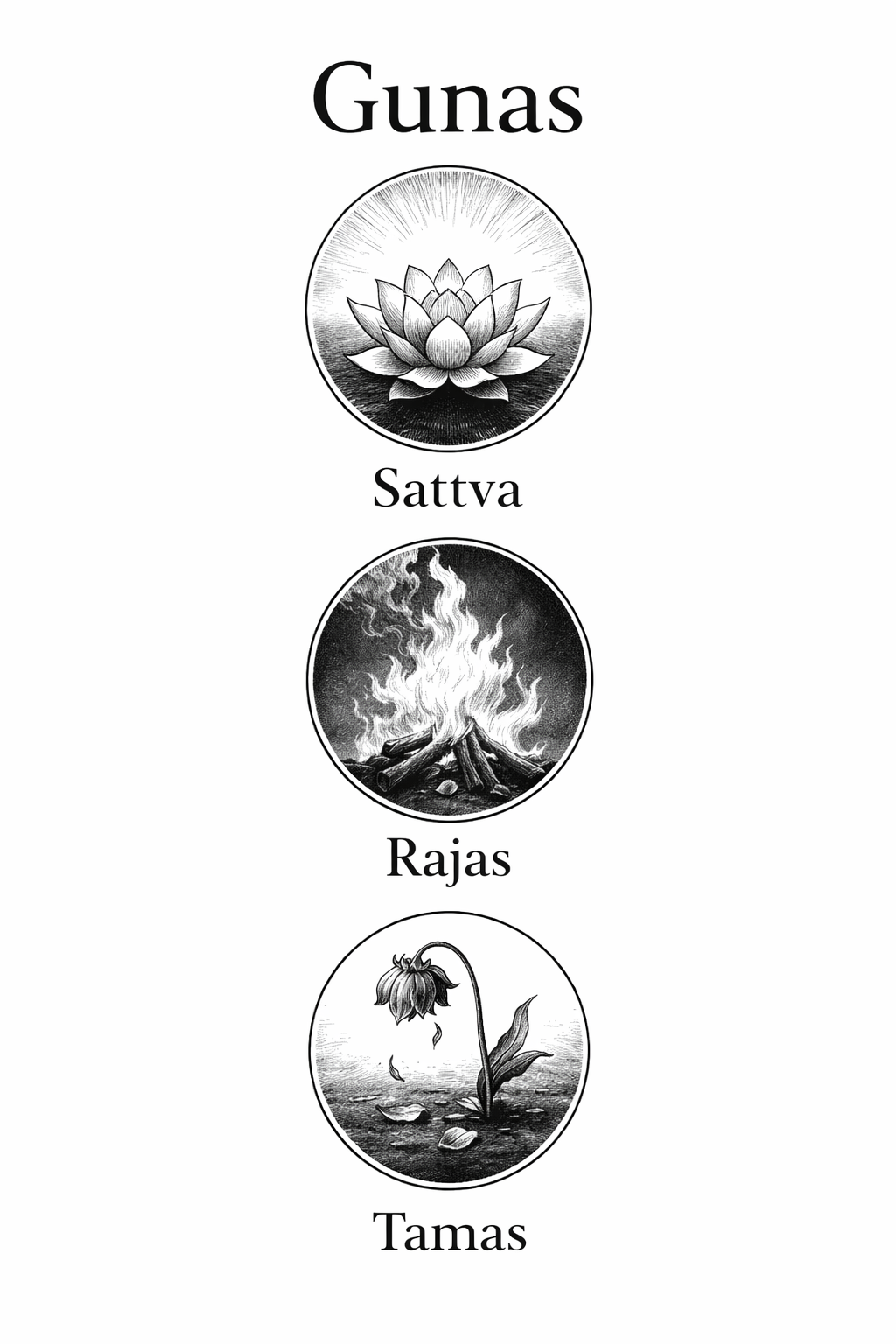
The three guns
In yogic philosophy, all of nature, including our bodies, minds, and states of awareness are shaped by three fundamental qualities known as the gunas: rajas, tamas, and sattva. They are dynamic forces, constantly interacting, constantly shifting, present in every moment of practice and every posture we take.
Yoga, rather than trying to eliminate the gunas, teaches us to observe them, refine their balance, and ultimately rest in clarity.
What are the three gunas?
Tamas is inertia, heaviness, stability, and resistance. It gives us grounding, structure, and the capacity to soften or surrender - but when excessive, it becomes dullness, collapse, or stagnation.
Rajas is activity, movement, effort, and stimulation. It is necessary for action, discipline, and transformation - but when excessive, it manifests as agitation, strain, or restlessness.
Sattva is balance, clarity, luminosity, and harmony. It arises when rajas and tamas are in the right proportion. Sattva allows perception without distortion and action without friction.
Crucially, sattva is not something we do. It is something that emerges when effort and release are intelligently balanced.
The gunas in Patañjali’s Yoga Sutras
Although Patanjali does not present the gunas as a standalone teaching, they form the philosophical backbone of the Yoga Sutras. The entire system rests on the relationship between prakriti (nature) and purusha (pure awareness), with the gunas as prakriti’s active constituents.
One of the clearest sutras is:
Yoga Sutra II.18
Prakāśa-kriyā-sthiti-śīlaṁ bhūtendriyātmakaṁ bhogāpavargārthaṁ dṛśyam
“The seen world is composed of the elements and senses, and is of the nature of illumination (sattva), activity (rajas), and inertia (tamas). It exists for experience and for liberation.”
Later, Patanjali describes how transformation itself is governed by the gunas:
Yoga Sutra IV.13
Te vyakta-sūkṣmā guṇātmānaḥ
“They (past, present, and future) exist in manifest and subtle forms, having the gunas as their essence.”
And:
Yoga Sutra IV.14
Pariṇāmaikatvād vastu-tattvam
“The essential nature of an object is determined by the uniformity of transformation of the gunas.”
In other words: everything we experience is the gunas in motion. Yoga is the practice of becoming intimate with that movement, rather than being unconsciously driven by it.
Observing the gunas in asana practice
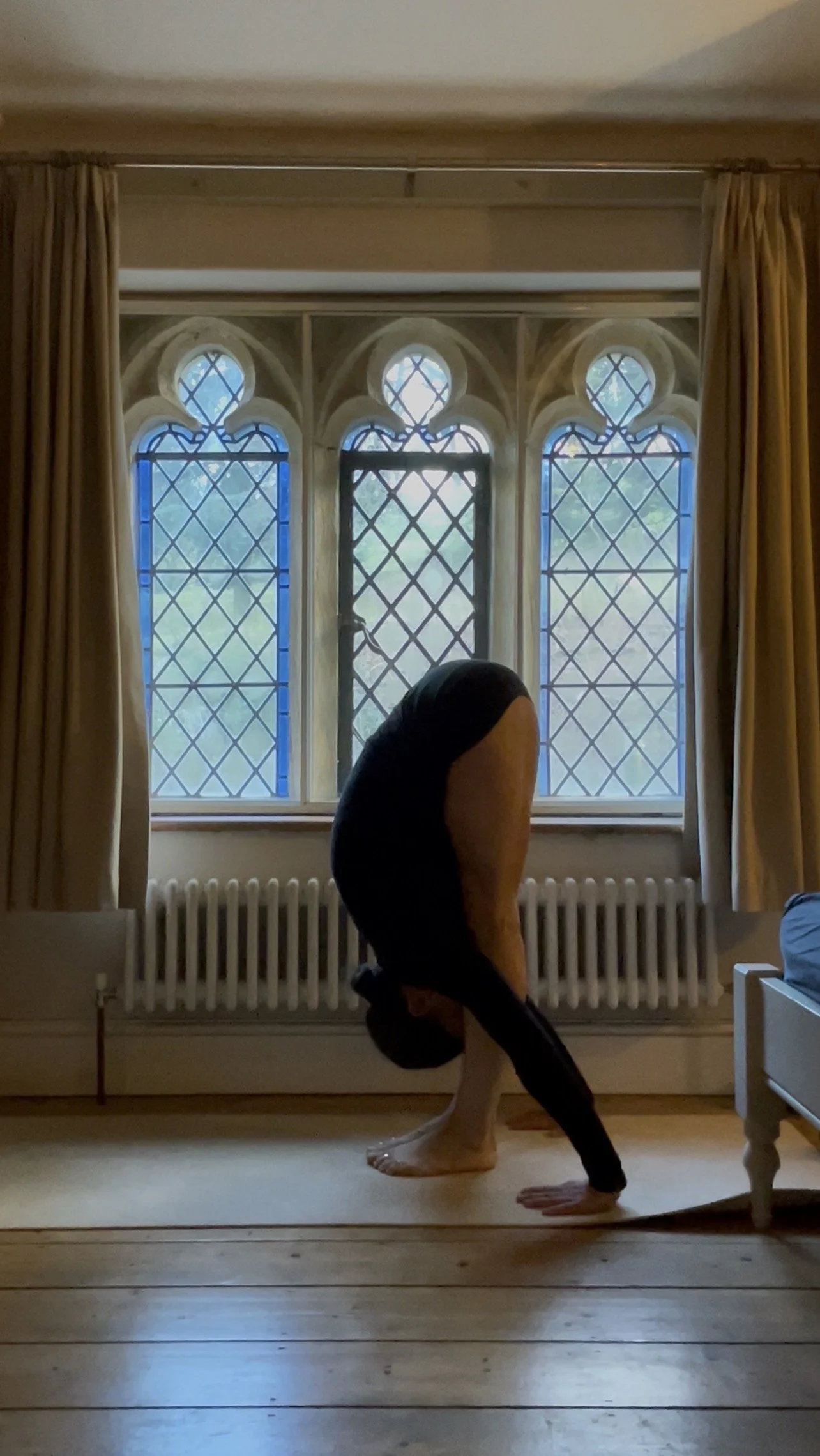
Uttanāsana
This philosophy becomes tangible the moment we step onto the mat.
Take Uttanasana as an example. For the posture to function intelligently:
The legs must be active, awake, and engaged - a clear expression of rajas.
The torso, neck, and inner organs must soften and descend, yielding to gravity -an expression of tamas in its healthy form.
If there is too much rajas, the posture becomes rigid and strained. If there is too much tamas, the structure collapses. But when effort and release are precisely balanced, something else appears: a sense of quiet integration, breath flowing freely, attention resting without struggle. This is sattva. Sattva is not added on top of the pose. It arises from the correct relationship between rajas and tamas.
Sattva as a state, not a pose
This understanding is beautifully illustrated in the diagrams from Light on the Yoga Sutras of Patañjali by BKS Iyengar, where pie charts depict different proportions of the gunas corresponding to various mental and emotional states.
In practice, this means:
Learning when to increase rajas to overcome dullness or fear.
Learning when to invite tamas to counter excess effort or ambition.
And most importantly, learning how to listen so the practice becomes responsive rather than habitual.
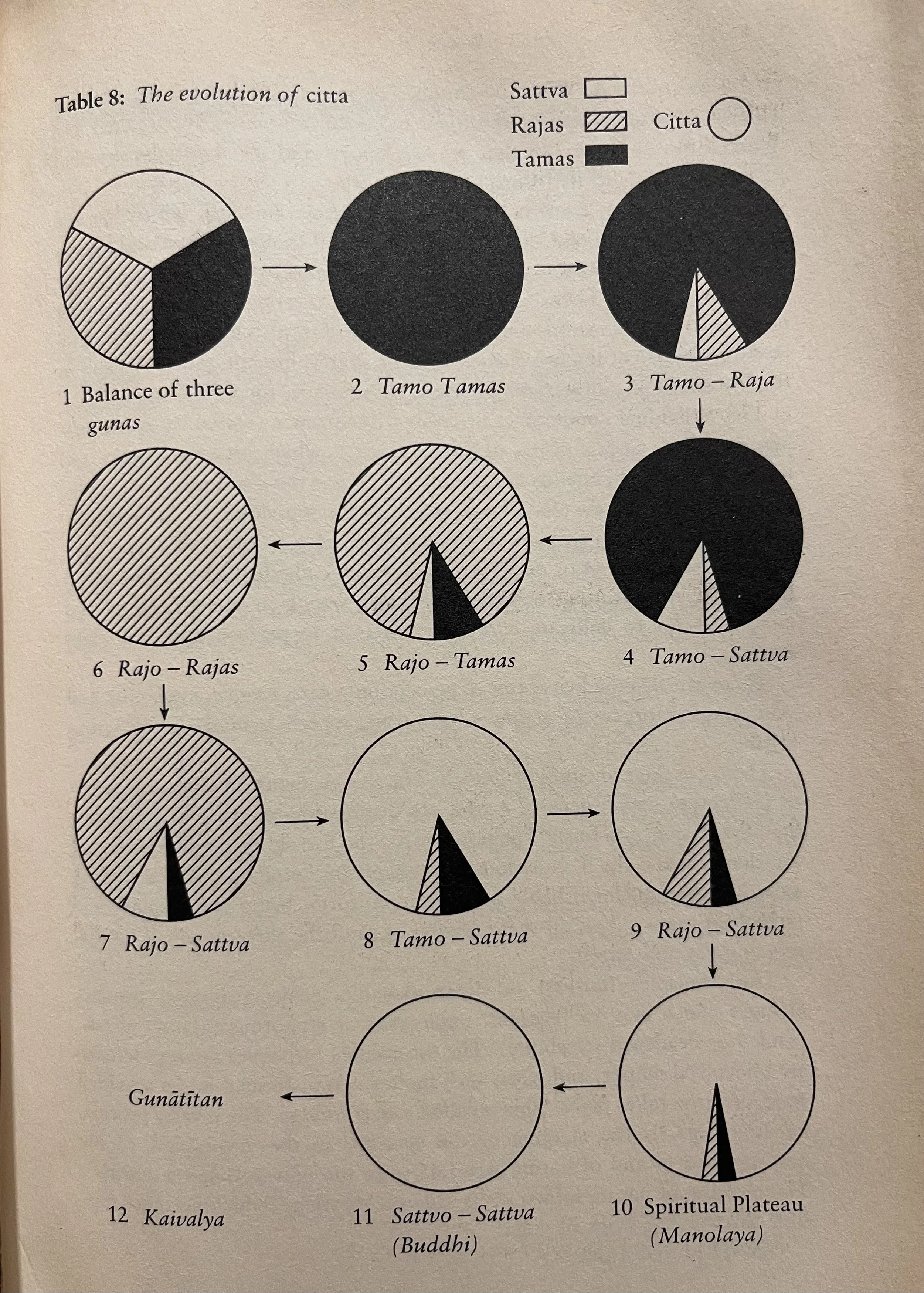
From BKS Iyengar’s 'Light on the Yoga Sutras of Patañjali’
From posture to perception
As practice matures, the mat becomes a laboratory for life. We begin to notice:
Where we over-effort.
Where we withdraw.
Where balance is possible, but unfamiliar.
Patañjali reminds us that liberation is not achieved by rejecting nature, but by seeing it clearly. When sattva predominates, perception becomes transparent and in that clarity, awareness recognizes itself.
Yoga, then, is not about being endlessly calm or perpetually active.
It is about learning the art of proportion.
And each pose, each breath, each moment offers us another chance to refine that balance.